Categories
brand business internet marketing organizational strategy

connected intentions

“When you use Buycott to scan a product, it will look up the product, determine what brand it belongs to, and figure out what company owns that brand (and who owns that company, ad infinitum). It will then cross-check the product owners against the companies and brands included in the campaigns you’ve joined, in order to tell you if the scanned product conflicts with one of your campaign commitments.”

We want to do good, make the right decisions. Eat green, wear helmet, give to the needy. What we say and want to do doesn’t always (almost never?) equal what we actually do. Attitudes and intentions might be there (I said I’d start wearing a helmet, and really meant to, for about a year) but behaviour is held back by barriers often ridiculous in nature.

The Buycott app, covered here in Springwise, is an example of a phenomena where those barriers, standing between intentions and behaviour, are lowered. When intentions are enforced and supported effortlessly, things can get interesting. Users/consumers tend to forget, but if forgetting gets harder, there’s even more pressure on brands.

Brands need to think harder (and try harder) to operate in a world where active and intentional (strategic) brand building more frequently is done through operational actions, decisions, etc, and less so through intentional brand communication.

Doing bad stuff has always risked ending up in the news or search results, but it (generally) demands momentum, a high “shittiness level” and a collective outrage. We’re alerted (and reinforce) though common sentiment and mass behaviour in a connected society. Connected information like this, which helps our intentions by becoming connected intentions, doesn’t. It becomes as individual as the wine suggestion app in a bottle store.

That doesn’t mean groups and social pressure doesn’t exert power on brand choice/decisions, but an added – again comparably effortless – nudge and reminder is potentially big. In a way it’s what connected and quantified self is/will be for daily health decisions in general.

Categories
design just a reflection nuggets ways of use

nuggets: purposeful design

the balance watch
from time differently

The balance watch (PSFK) – a very purposeful design to remind you of work/life balance. Reminds me, working with brands and overwhelmingly with communication solutions (yet not necessarily communications challenges only), that problems are affected/caused by the environment and the problem mustn’t necessarily be attacked on the level we see it. In this case; constant visual reminder in stead of perhaps a recurring yearly, quickly forgotten, resolution.

Client/agency relationship example: how much time/focus is dedicated to how you are going to solve a challenge? How you are going to work together? The fact is that solutions can be many and very different, and the how will unquestionably vary. Many great ideas die not because of the idea itself but because the parallel discussion around the process (the purposeful design thereof) of materialising it was missing (resulting in subsequent budget/timing/execution shock).

As a matter of fact, as creative agencies have more possibilities (types of solutions), speed is crucial and complexity an increasing variable – process is going (is) to be a great competitive advantage. Perhaps even the most important one.

Categories
advertising brand content marketing marketing storytelling video clip

modern day brand building – advertising as a byproduct?

Welcome to Detroit from Shinola on Vimeo.

This is a nice post by Edward Boches covering Shinola, a brand I myself just recently came across flipping through Men’s Style on Flipboard (ehrm), and how well they build their brand (so far).

What’s noteworthy is that this is not about building a brand in a new way, often including opinions around the death of TV, the insanity of bought media and extinction of print. And it’s not a case of proving how traditional advertising still works. It’s about how modern brands understand it’s not either/or, it all compliments each other, and that the most powerful thing is to have a purpose, and hence story, beyond – but not irrelevant to – the commercial interest.

This isn’t about going viral or driving millions of views, rather it’s more about telling the brand story, providing easily embeddable elements, and building a library of content that doesn’t feel as disposable as most advertising.

Boches

The thing with advertising being disposable and, in general, increasingly being disliked, distrusted and enjoying less acceptance is an interesting one. It’s not just that there’s more and more bad, lazy, poorly crafted advertising speaking in a voice that’s disconnected from reality, it’s that there’s often not much of a counter weight.

Advertising, at least as we tend to narrowly define it today, should be no more than a byproduct (and certainly not the sole product) of a commercially curious creative company.

Gareth Kay

People are ad literate enough to understand how advertising works – polished by agencies, constructed and often exaggerated – but if that’s all a brand is going to serve, then screw you. If a brand opens up and shows a greater depth, signs of being in sync with society, people, vision, reality, you are much more likely to enjoy a greater acceptance to your advertising.

Think about a great brand experience you’ve had, and how that affects your perception/acceptance of their advertising. That’s brand experiences in a broader sense.

Increasingly, to get meaningfully noticed is through delivering on the unexpected and over-delivering on the expected. Not very advertising centred, but very much commercial creativity.

Categories
advertising brand digital just a reflection media quote

the value, or not, of online advertising

From a brand communications perspective, some of the most interesting things happening are around new ways of connecting to people that, at least, buy or use your product. I say at least because today there’s nothing holding people back from promoting and selling your brand, if they dig it. And there’s nothing holding brands back from not making that more likely. I like what Rick Liebling touches on in this post about the future of retail, and how brand advocates can/should/will be viewed differently from an organisation-boundary-perspective. More thoughts on that in a later post.

At the other end, brands need to continue to “just lightly nudge” people into buying their services and products and display advertising is, from a user behaviour and media usage pattern perspective important. A few bits that are connected happened to pop up about the same time.

Google says that its technology could be a game-changer, in that it will create an advertising product that can command a premium.

“Display inventory to date has been limitless,” said Faville. “It could be that prices for viewable inventory become higher as advertisers’ confidence increases in the system. There is a high likelihood of these ads being seen as valuable to marketers.”

From The Guardian/technology

“The problem with television is that people must sit and keep their eyes glued on a screen. The average American family hasn’t time for it, it will never be a serious competitor to radio broadcasting.”
– The New York Times in 1939, by way of Dave Trott.

Via Gustav von Sydow

“Well-informed people know that it is impossible to transmit the human voice over wires, as may be done with dots and dashes of Morse code, and that were it possible the thing would be of no practical value.”
– 1865 Boston Newspaper, by way of Dave Trott

Via Gustav von Sydow

Premiumization is likely to happen. Exclusivity formats too. And likely to work, because it actually should work. We will break free from terminology like display vs ondemand TV vs online TV vs Broadcast TV etc and see more clearly. Nobody ever clicked on a TV ad, yet we know it works. Mere exposure effect is real, etc. Just a reflection.

Categories
future internet technology video clip what is around us

ICAs framtida vision en underskattning av tekniken

ICA delar i en film med sig hur de ser framtiden. En framtid de, antar jag, gärna ser och bidrar till. En otroligt krävande, påträngande och underskattande om du frågar mig.

När dina ägg är slut ska du inte bara tala om detta för en liten manick, utan följa upp denna upplysning med en beställning på nya. Kanske även antalet. Det funkar ju, men det är ungefär som de där människorna (ni vet vilka) som talar om att de ska maila, drar iväg mailet, för att 2 minuter senare dyka upp (fysiskt eller i SMS) och tala om att de har mailat. De utnyttjar liksom inte styrkan i tekniken (jo, jag talar om mail som teknik). Predictive technology ska ju ta handlar om just detta, exempelvis google now.

Inköpslistan som skapas av alla dessa krävande inmatningar i ett system (som under de första åren inte kommer vara optimalt utan en orsak till extrem frustration fattar man ju), pushas sedan ut till en stackars familjemedlem (eller slav, det förtäljer inte historien). Snacka om oväsentligt, påträngande strunt. Stackare.

Ska framtiden verkligen behöva vara så krävande?

Nä, så här kommer det inte se ut. Varför? För det första för att det är inte bra, och för det andra för att vi redan har teknik som gör detta på ett bättre sätt.

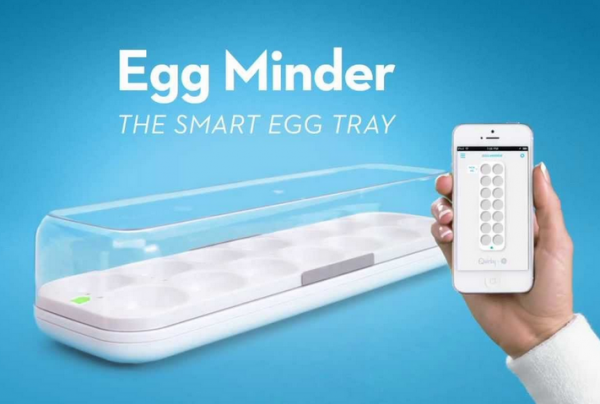
Egg minder by GE and Quirky
GE har, tillsammans med Quirky, som sysslar med produktutveckling (ofta en “framåtlutad teknisk inställning”) med crowdsourcing som metod, tagit fram en lösning på äggproblemet. Nja, kanske inte ett jätteproblem, men det är ju på detta sättet vi hittar rätt framtida applikationsområden och utföranden – på lite quirky vis… Egg minder hjälper dig ha koll på hur många ägg du har i kylen, samt hur gamla de är. Nästa steg är uppenbart – beställ när antal = x. Du bestämmer så klart, men behöver inte bry dig mer. Inget swipe. Inget inmatande. För varför liksom?

iBeacon är lite på tapeten för tillfället. Det står klart för de flesta att Apple sedan iPhone 4 meckat in iBeacon-teknik i alla lurar. Det är ungefär som jämfört med Bluetooth (det är faktiskt Bluetooth 4.0) vad en full och ansvarslös dörrvakt är jämfört med en nykter – “nej, nej lägg ner ditt leg, jag kommer ihåg dig det är lugnt välkommen in”. Alltså ta tag i en kundvagn och du är registrerad. Lägg ner ditt chip (som du ändå glömde i bilen).

Det är inte framtidens teknik, utan pågående teknikutveckling. Den blir bättre och bättre på vad den är där för; att hjälpa oss. Och i ICAs kontexten handlar detta mycket om att försvinna. Inte att aktivt interagera med oss. Interaktionsdesign och tjänsteutveckling (som den här) kommer, tro det eller ej, handla mindre om att swipa, klicka, peka och dra. Teknik kommer att försvinna, och då gör den ofta ett bra jobb.

Categories
business transformation creativity digital internet media organizational technology

#himc – a cheap first step towards changing a bit

For a very long time, Hyper Island have been using the #himc tag, which stands for hyper island master class, to share think pieces, concrete advice, brain food and absolute must-reads.

Many organisations need help and advice on how to make better (business) sense of emerging technologies and possibilities – and more importantly subsequent behaviours and implications for business and brand strategy – and I, personally, do a lot of work in that area (both as occasional hyper island collaborator, but primarily under the funny you should ask flag).

In all honesty, just by following the #himc tag (which cost nothing but a few minutes of attention), as they live by the sharing is caring rule of thumb, any company looking to better navigate an increasingly complex reality would benefit greatly. It doesn’t have to take much, but what is a required first step, is to start letting new perspectives, inspiration, opinions and realities through that filter called business as usual.


Categories
brand business business transformation digital organizational planning strategy technology

business transformation before digital transformation

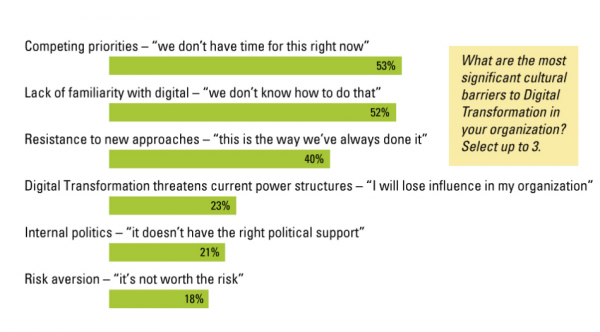
MITSloan presented some results from a survey about the need for digital transformation (companies face an imperative: adopt new technologies effectively or face competitive obsolescence as the study states). Results include an interesting, but not so strange, paradox:

  • 78% say achieving digital transformation will become critical to their organisations within the next two years
  • Only 38% of respondents said that digital transformation was a permanent fixture on their CEO’s agenda

I think this circles the most pressing issue and bottleneck; the interchangable use of digital transformation and business transformation.

Looking at digital technology (in whatever shape or form) from the level you stand, will not help you transform the business. Albert Einstein said that “No problem can be solved from the same level of consciousness that created it”. If you are expecting business transformation, you need to work on where that transformation might be going before you look at digital technology. Multiple answers will do too, scenario planning and future creation are exercises in plurality, but you simply cannot view things like you used to.

Despite growing acknowledgment of the need for digital transformation, most companies struggle to get clear business benefits from new digital technologies. They lack both the management temperament and relevant experience to know how to effectively drive transformation through technology.

Brand therapy in order to aim business transformation

So It’s backwards. Technology won’t give you the new future and reveal possible business benefits, it helps reach it and to an extent anticipate it. Companies need to revisit their entire reason for being, the meaning of them in peoples’ lives. Turn it inside out, because whatever you are now was created in a reality which is no longer. You need to go to brand therapy. Looking at yourself through the same old eyes simply cannot reflect a transformed image. You need a new level of self consciousness which means you have to have the guts (and realise the scope of a transformational process like this) to question old truths. You have to be prepared to redefine what you do (the business) as opposed to how you do things (the tools).

MITSloan survey, barriers to digital transformation

What I say is missing from this is the lack of a clear purpose and new self consciousness. The pieces that help give change a clear direction, reason and fundamental meaning.

Categories
business business transformation case

the ecosystem businesses are a part of

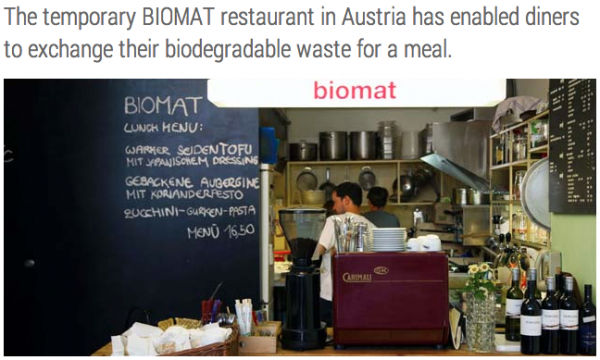
Restaurant accepts trash as payment

Examples like these might seem tiny, insignificant and maybe even fruitless. But I disagree. To every product there is a backside to the production, usage and remains. To all of this there is a business oportunity somewhere. And as businesses are pressed to rethink the entirety of their operations I think we’ll see more examples of significant size where reframing markets as an end-to-end eco system makes perfect sense. And if Unilever can view its Sustainable Living Plan as the business strategy there’s hope.

Categories
business social media storify work

M&C Saatchi Sydney Immersion

http://storify.com/addwax/mc-saatchi-sydney-immersion

Categories
advertising case ideas planning video clip work

Make your bedroom happy with Viking Beds

Viking Beds of Sweden from funny you should ask on Vimeo.

Viking Beds of Sweden, ett litet familjeägt företag ifrån djupa Småland, är ett trevligt varumärke jag fått stifta bekantskap med. Workshop, besök fabriken i Landsbro (som om allt går vägen är dubbelt så stor), sängprovande och slutligen köp av egen Viking Bed (jag skriver under på hur jädrans sköna dom är).

Efter intervjuer, observationsstudier, siffergenomgång och det sunda förnuftet hos de affärssmarta grundarna kommer man fram till att…dra mig vilken makt återförsäljarna har. Vi valsar in med ett par 3 varumärken i skallen (vilka vi också testar). Kanske en favorit, inte helt osannolikt genom rekommendationer från bekanta. Sedan står vi där med (felaktiga) uppfattningar om hårdheten, naturmaterial och individuella behov, men börjar mer och mer dumpa ansvaret på sovspecialisten (läs: säljaren). Hen ställer frågor av ergonomisk natur som vi lite ovant svarar på. Jo, jag har ju breda höfter. Nja, jag ligger nog mer på sidan. Det hela avslutas med den frustrerande och avgörande frågan, genom vilken ansvaret kraschlandar hos oss igen, “men i slutändan ska det kännas bra för er, vilken tycker ni själva bäst om?”. Tack för den. 30 lax, och den som känns skönast för mig gäller.

Vad gör man med högst begränsad budget (till skillnad från Hästens sängar när det begav sig), otroligt ambitiösa tillväxtmål och en stor geografisk marknad? Tro det eller ej, men TV-reklam flyter upp som det mest potenta första draget.

Make your bedroom happy kommer från observationen att sovrummet kan anses vara det mest mobbade, exkluderade och illa behandlade rum vi har. Speciellt när folk kommer på besök. Släng in den där grejen så länge, ställ in ostruken tvätt bakom sängen, ja men den kan stå där tills helgen, göm den här inne. Sängen är en sak, den ska (och kommer att) vara mycket skön. Allt talar för det, oavsett varumärke. Men stackars rummet då? Vi menar att sängar inte är så mycket annorlunda än bilar och kläder; vi vill känna att vi väljer, vi har ju stil, smak och tycke utöver en sned rygg. Sen väljer vi gärna det andra väljer ändå (hur många tror att den blommiga modellen säljer speciellt mycket, hur cool den än är?).

Viking Beds of Sweden skapas helt i Sverige. Teknik, material och tillverkning konkurrerar fint med de andra. Men bättre är att lyfta något annat. Valmöjligheterna och det faktum att som central möbel kan den göra under för ditt misshandlade sovrum. En misshandel du ofta erkänner dig skyldig till efter utfrågning.

Men så bred kommunikation trots återförsäljare? Jo, det är extra skönt och tryggt att välja något som inte är helt okänt. Speciellt efter ett ursprungligen rationellt förfarande, men i slutändan (och med säljarens hjälp) väldigt öppet och godtyckligt val. Då vill du gärna ha något du känner till, och vet att andra känner till.

Sen kan jag personligen tycka att något sängvarumärke borde åka runt med en buss, tuta som hemglass, och få alla stackars ryggar i kvarteren att komma in och provligga deras sängar. Det, om något, kommer du ihåg. (bumper sticker suggestion: “vill du sova skönt? Ta rygg på oss”. Ha!)