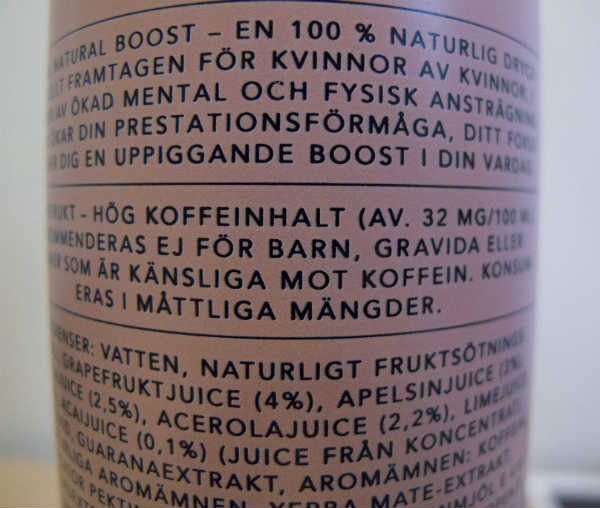
Stuff like this makes me go oh come on! An energy drink for women that should be avoided by pregnant women. Important to note is that there are energy drinks, not aimed at women specifically, that are all right for pregnant women to drink. Now that’s a disconnect between product and marketing if I ever saw one.
Author: funnyyoushouldask
I’ve always been intrigued by brands and the roles they play in our lives specifically and in society generally. I provide brands and organizations with strategic advice, processes and new ideas in order to make better business decisions with regards to this. I’m in commercial creativity, but am often refered to as a planner or strategist.
Along the way, I’ve had the pleasure of working with companies such as H&M, FedEx, Rusta, Dustin, Virgin Atlantic, Reebok, Adobe and many others. Types of projects include service design and branded utility, new brand development, social media strategies (often entailing organizational change management) and advertising. Even a bordello… I’ve built up a fairly broad set of skills and experiences by having collaborated or been a part of places like gyro.com, dga.se (formerly gyro stockholm), Medieinstitutet, doberman, Tre Kronor Creative/Tre Kronor Media, Hyper Island (Collaborator, Master Classes)

Det är inte första gången jag jobbar med poker och casino, dvs spänning, underhållning och den ständigt hägrande chansen att vinna stålar. Vilken är den största drivkraften om man nu ska välja mellan de tre? Ingen – det är en onödig diskussion, även om alla spelbolagsrepresentanter säger sig ha en klart bild på hur landet ligger. En som gör dem unika och tydligt annorlunda gentemot konkurrenterna. Jag håller ju aldrig riktigt med, men vi släpper det.
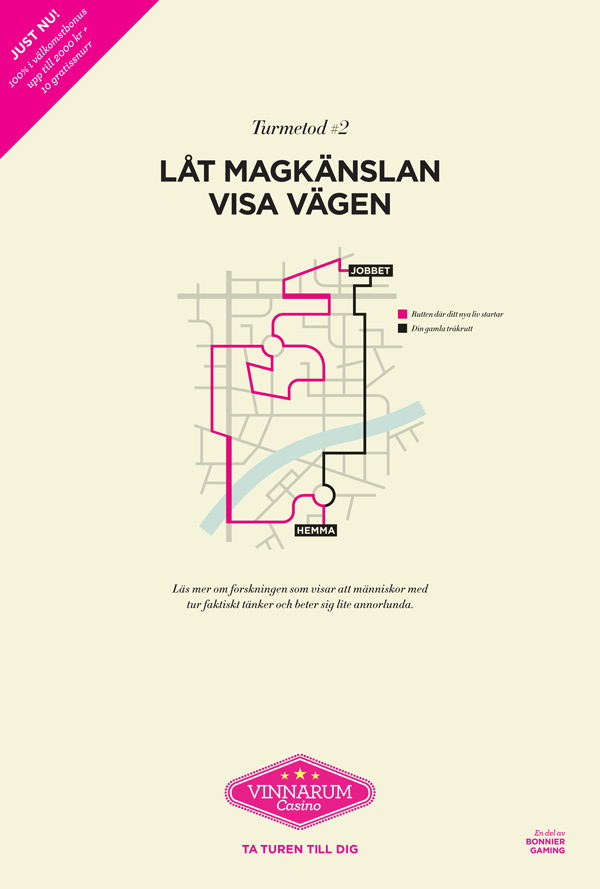
Vinnarum är ett svenskt Casino (ja, det kan faktiskt spela en viss roll att det är svenskt) uppbackat av Bonnier Gaming (ja, ännu viktigare garant) där strategiarbetet satte fingret på ett ganska intressant fenomen tycker jag. Inom casino och poker representeras ju i kommunikation nästan alltid någon aspekt av skicklighet, tur eller underhållning. När det gäller just tur har vi en tendens att tala i termer av antingen/eller. Inte bara “antingen har du det eller så har du det inte”, utan även som i “antingen så har man tur, eller så är man skicklig”. För de som känner sig skickliga kan detta med att ha tur vara direkt avtändande.
Men faktum är att det finns en hel del forskning kring tur, och det faktum att det inte är helt upp till antingen fru fortuna eller din exceptionellt begåvade hjärna. Nej, de två sitter ihop. Det tyckte vi var en jäkligt intressant och sporrande tanke som resulterade i uppmaningen att “Ta turen till dig. Aktivt alltså; se till att få tur.
Läs mer om tur, skicklighet och hur de samspelar i Richard Wiseman’s bok “The Luck Factor”
Vinnarum “Turmetoder” from Tre Kronor Media & Create on Vimeo.

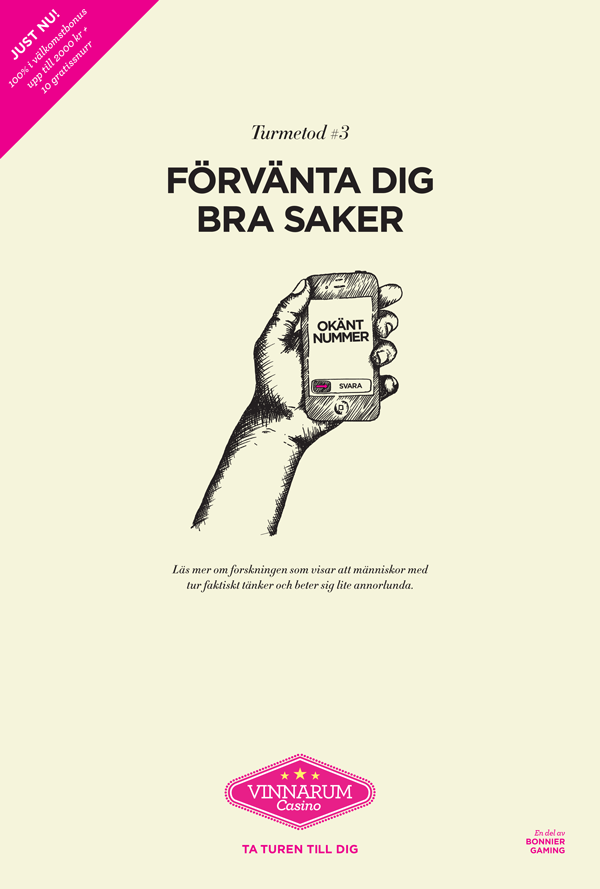
Vad tänker du själv när okänt nummer ringer?
I thought more than once in 2011 that, gosh it must be the year of intertextual ideas and executions given the vast amount of internet culture based ads. In Sweden, this was led by ComHem going all-in by trying to own associations to internet memes and all that’s beautiful with that.
Here’s a new, lovely, example from Nike. As usual the execution is perfect.
Some interesting thoughts, on the urban design note, from this year’s Picnic festival; urbanized technology. How cities “hack” technology that doesn’t take the context, i.e. city, into account. One example being the car, which isn’t utilized in the city in a way that the technicians behind it would have prescribed, if you will. Kind of makes sense. The new cars of today, the hybrids and the electrical ones, can be said to much better take this context into account. A hybrid runs on batteries in city environment and city driving; made possible not only because we have to cut down on fossil fuel usage, but because we know what city driving is like and so technicians and engineers take that into account.
It feels like much of the technological advancements we’re making today is about urbanizing technology. Or perhaps better explained; making technology contextually interactive. Giving data based on usage, and taking in data based on context. Urbanized technology is kind of the next step in every technology used. So we haven’t failed before, we just haven’t been there. Technology has been sand-boxed, whereas now it’s acting in an “object oriented programming” type of way. Manipulating other objects, and being manipulated by them.
I’m really looking forward to catching this latest film, Urbanized, by Gary Hustwit. Urban design is really interesting when you think about how little you think about it. How cities work, help you, work against you and contextualize your every experience more or less. Think about memories from, say a park, and how that memory could be claimed to be “powered by” urban design. How different could memories be, if the context had been different?
I don’t want to draw ridiculous parallels back to communications planning, but a session we had in 2010 at APG Sweden (Theme being “creating for people”) was with a company called Spacescape who specialize in strategic urban and architectonical analysis. Stuff like spacial analysis, user studies etc. They end up with things like heat maps, showing the flow of people, and hence how changes in the landscape would “upset”, redirect or prevent that flow. That session proved to have a whole lot in common with communications planning. It also left me feeling a bit incredulous towards architects in general.
almost photo slow mo
8 Hours in Brooklyn from Next Level Pictures on Vimeo.
via melex
Photos are so intriguing because we stare at them for a while, scanning the full picture, not missing anything. Then our mind wanders for a bit, trying to set or understand the context. Thinking about the specific, noticing gaps, filling in gaps. Really slow-mo film comes really close. It moves, yet you have time for the above. That’s quite cool I think.
There’s an important discussion going on here in Sweden at the moment, about online newspapers and the possibility to comment on articles, and wether or not it’s working. Some leading newspapers think it’s not at the moment. Leading representatives are heavily engaged in this discussion, that reached some sort of climax (and resulted in shut-downs or changes to the commenting functionality) due to extremely racist comments, but not solely because of that, during the tragic incident in Norway.
They are, quite rightly, looking at this from a technical, resource and reader involvement perspective. Recently a media industry expert (Sofia Mirjamsdotter, Resumé) said it’s no surprise that this happened (closing down, limiting and/or changing privacy policies) as none of the newspapers had a participation/comment strategy. That’s looking at things from a very narrow perspective given the massive impact of (possible) reader involvement in online journalism. You don’t have a strategy for comments, you have a strategy for online news publishing, if at all that’s what you choose to call what you do.
Anna Hjalmarsson of Aftonbladet hopes that in five years, they’ll have found better ways of handling discussions where readers openly, and respectfully, meet each other and newspaper representatives. She also says that many active commenters express themselves as if nobody from Aftonbladet is going to read what they write, as if the discussions in the comment fields is something for the readers only.
Now that’s spot on, and it’s most likely contributed to a negative language and a tone. If an official representative (i.e. article author) revisits and responds, well, we’d probably have a more nuanced discussion. Maybe even a professional one. A comment function has less to do with the possibility to make yourself heard, and more to do with getting a response, a reaction. We talk to/with people. If the response is from somebody calling you an idiot, wishing you dead. Well.
Björn Hedensjö of DN.se says they’re genuinely interested in reader involvement, but at the same time they have limited resources. He says that the editors must make an active selection when it comes to which subjects should be discussed and then also engage in that following discussion. That’s a very good start. Selecting what articles and pieces are most relevant and likely to inspire, and facilitate, discussion. And because selecting is already a key aspect of journalism, it’s a natural extension of that. What is news worthy and what’s not, is a constant question. Why shouldn’t what is talk worthy? Often they overlap, but far from always. They are different and have different selection criteria. Especially considering the resource issue.
So considering this, I think we arrive where the real challenge sits. The key question with regards to journalism in general today, is the role it plays in society. Media (organisations), traditionally defined by the properties of the specific media (TV was always very different from radio, technically speaking), the organizational structure (ownership and possibly political associations) and funding/financing (licence and/or ad financed).
Media has always been institutions in society. They’ve always helped shape culture in the broadest and biggest sense. But newspaper journalism has mostly been about them writing and telling us about things. It’s been about sender-receiver. It’s been like that because of the technical context when it started, and when it was defined, explicitly or not. The technical properties of media used, did that. It’s all a product based on what was even possible. Now that’s changed. When an article starts and stops is changed. Finite has become infinite. What news story telling is (can be), has changed. So really what needs to happen, which is the reason it’s not about a strategy for comments, but rather a strategy, and definition, of online news journalism, is rethinking the sole purpose and role of online journalism. Which, of course means, the role of journalism in general. In this case mostly, but not exclusively, from a written word point of view. I really hope the question is answered on this level, and not mostly on a technical level, as many comments seem to suggest.
bean shaped luxury
There’s big luxury and then there’s small luxury. One of my luxuries is freshly ground coffee on Saturday and Sunday. I can’t be bothered during a work week. It’s a good idea to identify what your small luxuries are because you get more luxury in your life without breaking your wallet or going round the world. It also helps if you remind yourself that it’s luxury and not just ordinary. Just like advertising increases perceived value, and hence real value, so can reminding yourself about your small, everyday luxuries. I believe. You could also call it fooling yourself, In which case I don’t mind.
Lovely execution and craftsmanship that gives you a reason to look closely. Posters don’t have to be flat. Via Britny.

flick by programwitch
I was wearing Carhartt jeans the other day. Also a Carhartt shirt and a Carhartt jacket. Am I a big Carhartt fan? Well I’ve got a few shirts yes, I’ve got one jacket and one pair of jeans. I wouldn’t call me brand loyal, but I wouldn’t blame anyone for thinking that.
Without repeating all that’s been said about the concept of brand loyalty and it being contrasted and questioned, even disproven, in Byron Sharps book How brands grow, I’ll add my two cents, and it’s really just a way of thinking about it.
“Brand loyalty is having first dibs”
That’s what it comes down to, and little more than that. I’m not loyal to Carhartt, but I’ll swing by their store in search of a new pair of jeans before any other, if convenient enough. They have the first chance of maintaining their track record, but it takes little for me to walk out and into another store. We tend to equate, or define, loyalty with the latter part; it taking little for me to walk out and the fact that loyalty should be about me not easily doing that. But it’s more about the former; a brand simply having first dibs. We’re looking for a bit too much in the loyalty concept. If first dibs is what we equate with brand loyalty, we have the research and data to back it up, as opposed to over inflated wishes for loyalty beyond reason.
The fact that it’s more about first dibs, and little more, means the pressure is on the brand to continue to satisfy me. And that’s brand loyalty seen from the other end.

Twitter