
About funnyyoushouldask

I’ve always been intrigued by brands and the roles they play in our lives specifically and in society generally. I provide brands and organizations with strategic advice, processes and new ideas in order to make better business decisions with regards to this. I’m in commercial creativity, but am often refered to as a planner or strategist.

Along the way, I’ve had the pleasure of working with companies such as H&M, FedEx, Rusta, Dustin, Virgin Atlantic, Reebok, Adobe and many others. Types of projects include service design and branded utility, new brand development, social media strategies (often entailing organizational change management) and advertising. Even a bordello… I’ve built up a fairly broad set of skills and experiences by having collaborated or been a part of places like gyro.com, dga.se (formerly gyro stockholm), Medieinstitutet, doberman, Tre Kronor Creative/Tre Kronor Media, Hyper Island (Collaborator, Master Classes)

Find more about me on:

Here are my most recent posts

Categories
brand business organizational social media

social media the organisational change agent


Photo thanks to riklomas

I came across two new reports on how connectedness, new touchpoints and feedback loops are affecting organisations, the marketing function and “where it sits”, and also increased customer centricity. They sum up the greater context, and the combined reasons, for some of the organisational changes (or needs for) that need to happen. One report from McKinsey (We Are All Marketers Now) and one from Forrester commissioned by Dell (Social Listening).

Forrester found that organizations across various industries that have implemented listening and digital engagement initiatives are starting to see impressive business returns.
– Forrester

You often hear negative voices on showing ROI from social media within marketing and it’s a fair point because getting measurements right isn’t that easy and, obviously, neither is actually generating a positive ROI. But a positive ROI should be delivered through social media implemented into, and used by, the whole organisation and not just marketing, which changes the ROI conversation, the investments and the over-all value it brings. You might even argue that it redefines marketing, which is what McKinsey are arguing.

In the era of engagement, marketing is the company… In essence, companies need to become marketing vehicles, and the marketing organization itself needs to become the customer-engagement engine…
– McKinsey

In today’s marketing environment, companies will be better off if they stop viewing customer engagement as a series of discrete interactions and instead think about it as customers do: a set of related interactions that, added together, make up the customer experience.
– McKinsey

Which means there’s an increased need for designed and coherent interactions that stem from a better agreed understanding of who the brand is and its meaning in people’s lives. If it’s too much for one person to be responsible for customer engagement, then companies (realistically larger size ones) might consider having one for every function within the organisation, who can then liaise with each other in order to cross the boundaries that exist between sales, marketing, customer service etc.

The marketing organisations new look, 4 key dimensions identified by McKinsey

Distribute more activities
If marketing is the company, the distribution of marketing activities changes.

More councils and partnerships
As distribution of activities change, new needs for synchronization and collaboration cross-boundaries emerge.

Elevate the role of customer insights
With more and better feedback loops and data waiting to be tapped – all aspects of the company can and must benefit.

More data rich and analytically intense
Apparently Zynga generates and captures five terabytes of customer data every day. Wow!

Helping companies understand and benefit from social media is enough to realise that we’re looking at some major organisational issues. It’s all organisational, and organisations are tricky. It’s complex and it’s slow. It means shifting incentives, responsibilities and accountabilities. Many companies are going to have huge problems for a long time, and some companies offering organisational change management are going to get rich…

Social media is helping bring companies closer together internally, and perhaps it’s even the strongest catalyst for better cooperation, cross-department co-operation and incentivising for over-all collaboration. Quite an important roll.

Categories
brand digital just a reflection social media strategy video clip ways of use

amex, small businesses and the concept of sponsorship

I vote for this guy not only because it looks delicious but because he seems like such a great guy.

But It’s a tight race because these guys are doing exactly what I’m missing; fast food that’s good for you. I just want some good ol’ fashion husmanskost on the go, but all I can find is fat dripping pizza on every damn corner. Hate that.

And I’m very impressed with the Amex Open Forum initiative and the momentum they have. Even though I’m disappointed by the card (at least in Sweden and online). From the small business saturday idea (below), to partnering with Facebook to provide “an Amex way” of paying for ads, and Vote Big Break above.

Being involved in a sponsorship strategy for another big global American brand, I can’t but help but reflect over the role of sponsorship. Simplified being about 1, brand awareness, and letting context/sponsored event/team/sport/etc indicate what the brand supports and affiliates itself with and thus 2, manifest position/meaning by getting a brand attribute rub-off effect. But there’s so many examples of very weak sponsorship strategies where all you get is your logo out there with very little meaning attached to this.

Not so long ago, It was impossible for Amex to do what they’re doing here, which is sponsoring small businesses and everything that comes with that; having to struggle, be a smart marketer (perhaps first time at it), smart with money, doing a bit of everything (balance sheets and tax laws anyone?), and being frustrated with hardly making ends meet. Sponsoring them by doing things for them is something that simply could not be done before. Not with this massive reach and impact. To a large extent this falls under sponsoring in my book. Supportive sponsoring. Extremely targeted and relevant. I think the concept of sponsoring is changing quite a bit.

Categories
design digital technology video clip ways of use

arduino – a perfect open source wedding

Hadn’t seen the documentary about the Arduino project before. I was struck by the the 3D printer built on open hardware Arduino, printing open source coat hangers and how this is the ultimate wedding of the connectedness, collaboration and openness of the internet, and how that is power in numbers. I’ve been facinated by MIT Media Lab for a long time, so was happy to find that representatives of MEDEA Collaborative Media Initiative down in Malmö, Sweden, were part of the Arduino project, although started in Ivrea in Italy (Arduin being an important character for the city of Ivrea) and soon consisting of a great mix of people and co-collaborators. Watch the film, there’s an interesting story behind the hardware and an inspiring case of collaboration across boarders, based on mutual interest.

Arduino The Documentary (2010) English HD from gnd on Vimeo.

Categories
digital just a reflection technology video clip

real-time translation technology and implications

Ray Kurzweil on Translation Technology from Nataly Kelly on Vimeo.

From Singularity Hub

I wonder if we have any idea (well we have some) of the possible implications of this? I mean, the obvious ones are, well, obvious. But what about the role language plays in keeping societies and cultures intact. That is, actually feeling like a specific culture as opposed to all other cultures. In socialization and learning a language amongst other things, you get spoon fed your culture (albeit small spoons). What you say where and to whom and in which situation is different between cultures, so imagine instant translation amongst foreigners. It’s bound to have an effect. Imagine not being able to keep things from foreigners?

It’s like the equivalent of people mistakenly posting a little too much on Facebook and hence to everyone, but in use of language. Instant translation gadgets would effectively force you to mind your every word and not just your every Facebook post. Ubiquitous real-time translation that you might not even be aware of in any given situation. Oops.

Categories
advertising business creativity just a reflection

a friendly poke at CMOs over at Forbes

I t’s creativity award times and the best advertising (although the advertising part was dropped from the award description this year – thank you) is being scrutinized down in Cannes. There are many different points of views on creativity but I think there’s only two sides and one is wrong. If awards is the end you’re aiming for – you’re way off. If you view it as a good gauging tool for the business effects you tried to achieve – no worries.
Here’s a short piece I wrote for the Forbes CMO network the other day, on the subject but not for Cannes reasons.

A couple of weeks ago I had lunch with an at-the-time hopefully future client. We had shared some early thoughts on how to help their brand grab a substantial share of the very competitive market they are in. One representative said we had to forgive him for being very skeptical of an industry that “only wants to win awards.” He didn’t express this in a disrespectful way leaving me the chance to respond, and there is a very good response indeed.

We know that advertising works. But we also know a great deal more about what type of advertising works and why. Many advertising greats, often equipped with acute observational skills coupled with a large dose of empathy, always knew this. Obviously it would only pass as ‘being pretty sure’, whereas now we know that creativity really matters in business.

No one buys an ad. I should hope. You invest in better business results and advertising is a means to that end. It drives short- and long-term results. The two are tightly linked, and one might argue there’s not one without the other. We know increasingly more about why this is, thanks to an increasing amount of research on advertising effectiveness. CMOs, agencies – marketeers in general – should keep a keen eye on this, because otherwise we’ll never know if all we bought was an ad.

This is very well described and exemplified in ‘The link between creativity and effectiveness’, published by the IPA in 2010 (you can find the report here). In fact creatively rewarded campaigns are on average 11 times more effective than less creative campaigns.

Pretty good news for anyone responsible for investing in better business results. And pretty interesting to then look at one’s own advertising, and analyze and reflect.

So far so good. But based on my subjective experience, I find it a bit strange that you meet so few CMOs, heads of marketing or advertising, who actually know about these things. Especially in a B2B context, which isn’t as different from consumer as many people would have you think.

Why is this?

Shouldn’t this be as prioritised in clients’ organisations as it is in agencies?

And on that subject I read another Forbes piece on client’s views on awards, and it doesn’t exactly help me calm down. I mean, what can you say about the following reasoning by a CMO?

While the benefits for the agency from winning awards, what’s in it for the client? I was shocked recently when the CMO of a top, nationally recognized company, one that has won many awards over the years, told me that he believed that he is entitled to pay his agency a lower fee because the agency benefits financially from his award-winning account by picking up other accounts.

My marketer friend wondered why the agency could be leveraging the awards to win new business, while the client gets no financial benefit from those awards.

Being entitled to pay the agency less is another matter and I don’t think I’d be able to behave had I been there. But the second part about not getting any financial benefit is equally upsetting. Because like I wrote, it shows how very little some of these people know about the stuff they should know a great deal about.

Obviously it isn’t a clear cut case. Not all award winners have proven very effective and there’s a lot of bullshit “hey look how cool things we dream up” examples that understandably adds to some skeptics’ opinions on creative awards. But damnit we have to arrive at some basic level, general knowledge around creativity and business effects in the suit world soon. It’s upsetting if not even ridiculous.

Categories
advertising brand digital media social media video clip ways of use

it’s more fun to run the scull

As usual some really great work from Nike. Even though we’ve seen the idea and the mechanics before, it doesn’t make it less good, engaging and effective for the people activated. And I love the offline/online aspects of ideas like this. A physical run turns digital graffiti turns t-shirt.

Categories
digital internet media stats ways of use

generalizing based on the few non-TV watchers

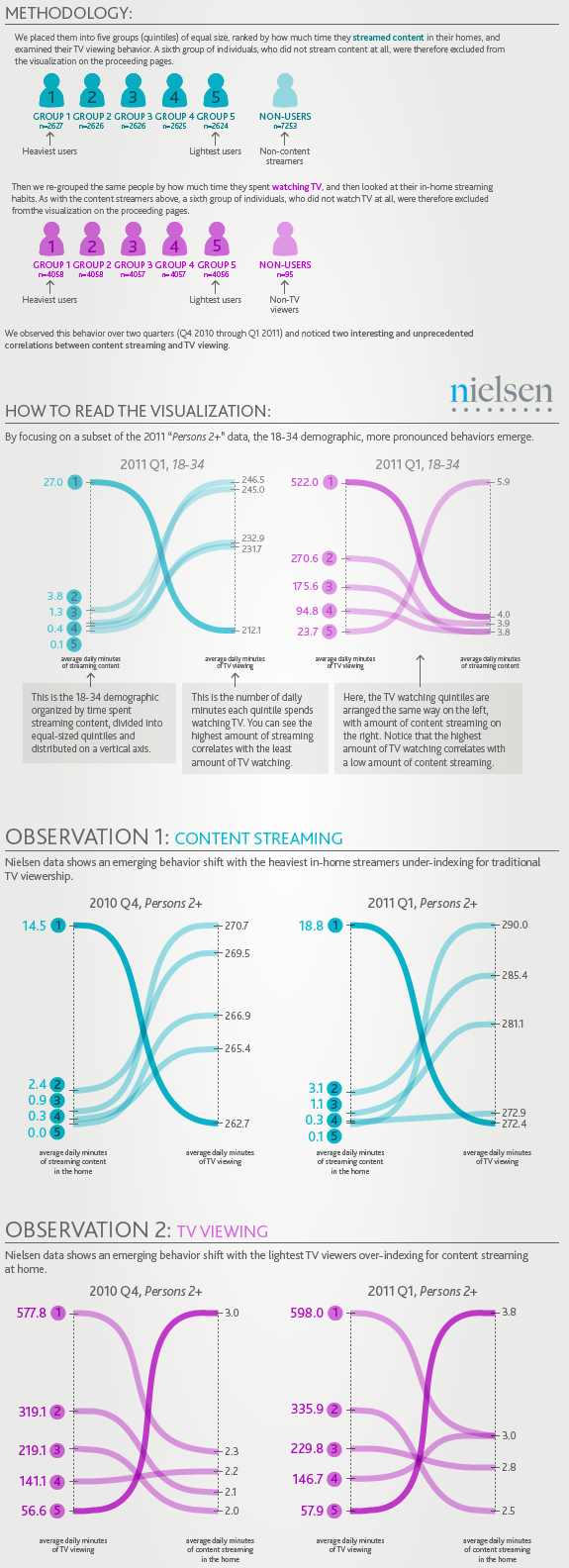
This infographic from a Nielsen Cross Platform report shows how easily some breaking stats, such as some people streaming a lot of content and watching very little TV, can be taken for a general truth just because the over-all feeling of a digital tsunami is over us. I’m referring to the TV is dead claims, often taken for a truth. But yet again, statistics show us that that isn’t the case. Americans watch more TV than before.

However, there are consumption changes to keep an eye on (well, if it interests you…). The heaviest consumers used to be so across all platforms, but a subset amongst 18-34 indicates that (some) top consumers of streaming content under index in TV viewing. Fairly expected though as internet content catches up in quality and supply. See report.

I keep wondering how damn much content and watching we can take and have time for.

Categories
business internet just a reflection technology video clip

the revolution that wasn’t a revolution

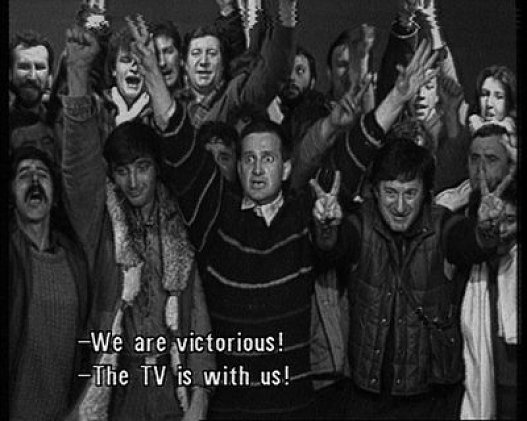
A man in a large crowd stares into the camera. His eyes are wide open. If you didn’t know what was happening, you’d have a hard time telling if he had a stare of anger, victory or happiness. It was a mix of all three. He was in the start of a revolution.

There was a panel discussion at FutureEverything in Manchester some time back, about digital and the future. Ela Kagel, a curator focusing on free culture and the open web, had a talk about value transfer, crowd funding and the challenge of future revenue models for artists and cultural workers. It’s a very interesting subject, and indeed her project called Free Culture Incubator is too.

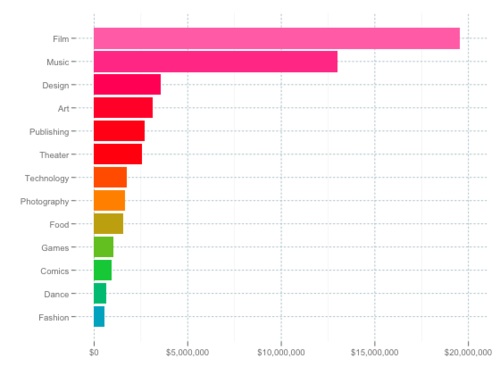
What I find quite interesting with this is that arts grants and other official cultural support functions have been about the process of creating art. Support for the doing, so that artists can then sell the final product. And although many artists, who have always struggled, may find bootlegging and copying a major problem and maybe even a spit in the face, they now have so many new ways of getting support for the process and the actual doing from a much larger community. A visionary idea or project like Molly Crabapple’s Week In Hell can get $17,000 from supporters that don’t know what’s going to come out at the end. We don’t just buy the final art, we buy into a thought, idea, culture or movement. Below is a graph of the different types of projects that get funding from Kickstarter.

“Are we prepared for after the revolution?”

That was the key question that made me squirm in my seat up in Manchester. “Are we prepared for after the revolution?” Well that makes no sense at all, which, seen as I can’t shut up, proclaimed loudly. I got a quiet stare back. The fact of the matter is that only if you’ve been asleep for the last 20 years can you wake up after a revolution. What we’ve been in for quite some time now (quite being the key part) is an evolution and not a revolution. An evolution that many have handled brilliantly and others not so brilliantly. But to blame it on being a victim of a revolution is crazy. Revolutions explode. Those prepared for this revolution are those who saw it as, and treated it as, an evolution early on. Those interested in, or at least realizing, the change. So the question has the answer already. For those who see it as a revolution; no, you’re not prepared.

Why is it important to distinguish a revolution from an evolution? Because it better helps corporations, organisations and brands making sense of it all. That it’s not making sense of something new, but continuously making sense of ongoing change. It might be about an implementation. Only not a solution, but rather a mindset or approach. The quicker they come to terms with the fact that never again will it move so slowly, the better. It’s not a change. It’s change.

But still, wise words from a man who wrote poetry from his thoughts about revolutions. Revolutions will not be televised because the actual revolution has already happened in the hearts and minds of revolutionaries. That cannot be televised. Revolutions, he said, happen within. Only the effects can be viewed and broadcast, and here’s how it looks.


Romanian revolutionaries taking over mass media, a good sign of a revolution.

Categories
creativity design technology video clip

i agree with everyone; The Mill rocks

I agree with everyone else; The Mill is simply extraordinarily, amazingly, awesomely great. I got one or two goose bumps watching this.

The Mill US Showreel 2011 from The Mill Visual Effects Studio on Vimeo.

Categories
creativity internet technology video clip

ultimate artistic expression of remix

Kutiman is at it again. To me, his musical video mixes are the ultimate artistic expressions of what remixes are today. It’s less than professional (but he is a professional producer I hear) in the traditional sense i.e. source material is user generated, distribution is free spread is self-propagated etc. This particular one he’s shot and directed himself which, funnily enough, could be considered taking a step back seen only from a UGC point of view… But who cares.