Location really was the missing dimension of digitally mediated [personal] communication. The variable that made the question “where are you” or “where is that happening” redundant. Of course a call to a mobile phone still calls for it, but not too seldom my calls are triggered by a check-in I’ve seen.
Where someone was when you called them was never unknown before. You called someone and if they answered, they were home. Or at work, or wherever you called to. You sent someone a letter and if they received it, they obviously came home. An early question upon calling someone might, however, have been where have you been, and that question held much more interesting information than where they were at the time of the conversation. As that’s wherever you called them.
You can tweet and move. A tweet here and a tweet there. Another person tweets here and tweets there. With location meta data you can see tweets in your vicinity. Check-ins let you see where friends and others are at. Small messages floating around everywhere and often they have very little to do with the location other than the fact that you were there just then. Check-ins are just that.
But as soon as we gather for a venue at a place, a hash tag gives the place a twitter feed. The feed belongs to, or originates from, a place. The belongs to part is what I think is a lost aspect that holds some potentially interesting ways of discovering things from the past at that spot. It’s quite interesting if that feed, with a hash tag working as the shepherd, were to be connected to the spot for that venue. Continuously. Not just the initial check-in that serves as a “Hi, I’m here”, but the ongoing conversation. They tend to part ways as the participant’s communication, about whatever the venue is about, starts flowing.
I’d like to find locations with feeds attached to them, and discover stories told from that place. To find out that, for example, music lovers had a Bob Dylan night at [location] 2 months ago. Just from being at the place. And being able to find parts of their discussions. Perhaps I’ve found a music lover cafe.
But It’s like my colleague said: “Real time is nothing after real time”.
It’s true. Just after real time, it’s nothing.
Just recently there was a gathering about the digital world called SIME (funnily enough this was discussed: The age of information is dead and the era of storytelling just began. and I’m using it as an example of how we could be stumbling over stories. How appropriate.). Some of the discussion can be found at #sime10 (don’t know for how long), and physically it took place at Cinema Saga. If you check in today (29th Nov 2010) you’ll see it’s the Stockholm International Film Festival. You won’t, however, discover that SIME 2010 took place a week before. And you will most certainly not find that SIME 09 was held in the same spot a year earlier.
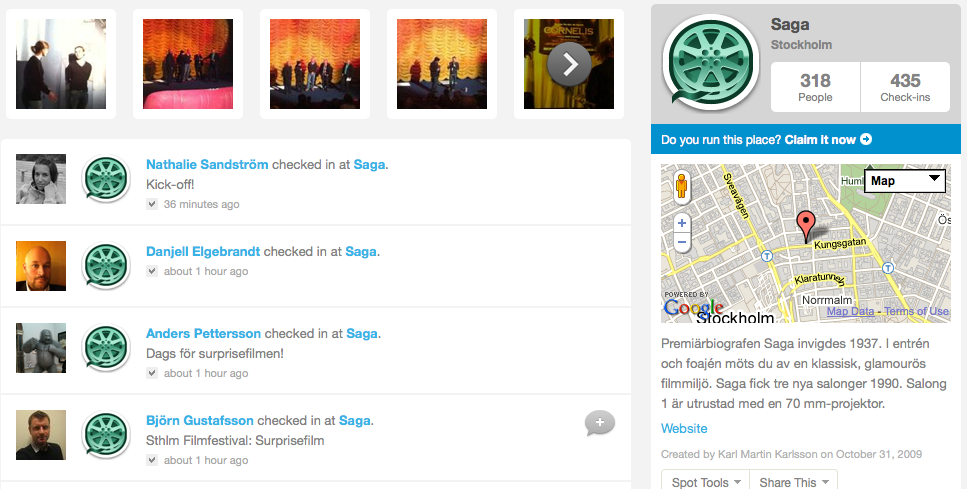
You’ll find recent check-ins, who’s checked in most, but nothing about what took place here. I think that would add something useful to a place. I mean Google is intangible discovery first while a check-in is a tangible, location based, discovery first. I think the two need to be more tightly connected in the later case.
The check-in is a “story” starting point and #sime10 the story unfolding from that place. I think it’s only right that it partly sticks to that place.
But I really enjoy coincidental discoveries of a third kind of whatever it is I’m writing about here. They make me smile. They are check-ins with comments to spots created while in a car queue or some other passing situation or event. There was a queue here, but not anymore. Another person was here, in the queue, but not anymore. That person, at that time, was pissed off and told us in a comment. He/she is not pissed off anymore (I should hope). Nothing is really there anymore. Yet the comment is always what feels most real and most present to me. That’s science fiction.